
Foot Care and Healthy Tips
Protecting Every Step You Take
Foot Care & Therapeutic Footwear
Healthy Feet Are the Foundation of Mobility
For patients living with diabetes, neuropathy, or foot deformity, most serious complications begin as something small and easy to miss. Daily inspection, properly fitted footwear, and regular professional follow-up prevent the majority of them. This page covers what to watch for, how to choose shoes, and how the Medicare therapeutic shoe benefit works.
Daily Inspection
Check Your Feet Every Day
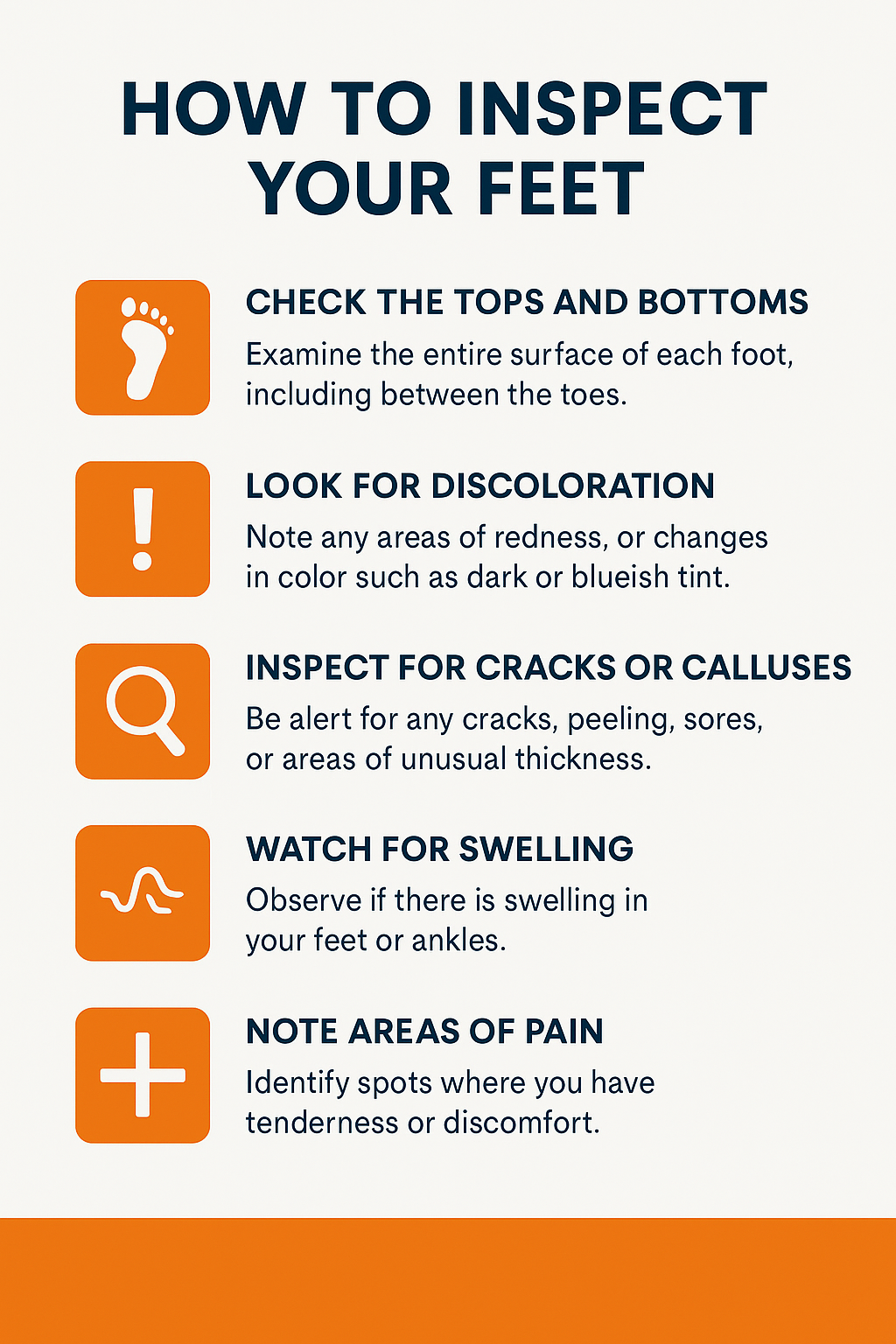
Neuropathy can mask pain, which means a blister, a cut, or a pressure sore can develop without you feeling it. A daily check takes under a minute and catches problems while they are still minor. Look at the tops, the bottoms, and between every toe.
- Redness, cuts, sores, or blisters
- Moisture or cracked skin between the toes
- Swelling in the ankles, toes, or arches
- Thickened nails, corns, or calluses
- Warm spots, which can appear before skin breaks down
If you cannot reach or see your feet, use a mirror on the floor or ask a family member to check for you. Do not skip it.
Footwear Selection
How to Choose the Right Shoes
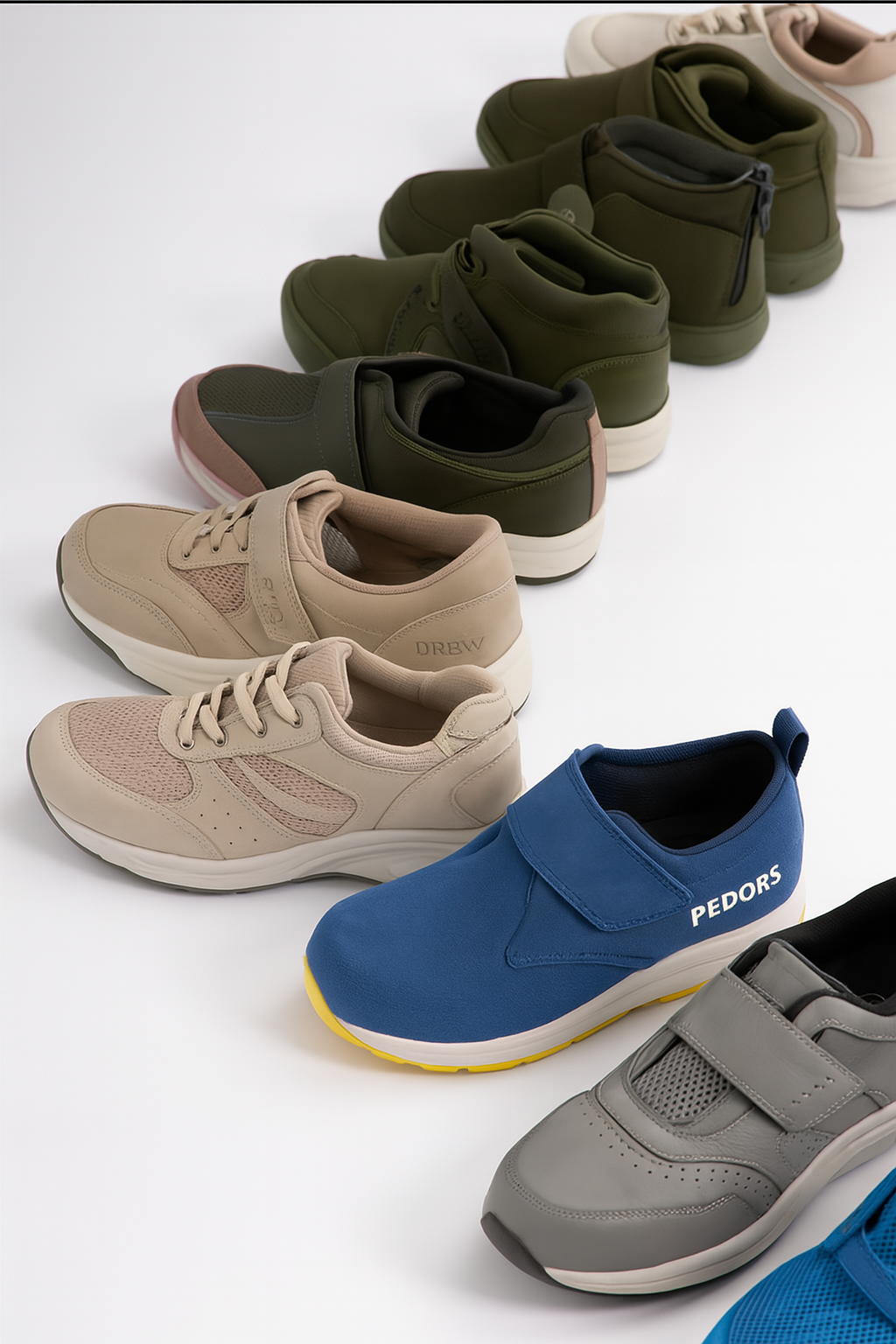
Footwear does more to protect an at-risk foot than almost anything else a patient can control. The right shoe distributes pressure, accommodates swelling, and leaves room for an orthosis without crowding the toes.
- A wide toe box and a deep footbed
- A cushioned heel and adequate arch support
- Adjustable closures such as laces, straps, or stretch panels
- A structured heel counter that resists twisting
- A removable insole, so a custom insert can take its place
- No high heels, no stiff soles, and never barefoot at home
Shop for shoes late in the day when your feet are at their largest, and always bring your orthoses or braces with you so the fit is tested the way you will actually wear them.
Medicare Therapeutic Shoe Program
Shoes Covered by Medicare Part B
Medicare Part B covers therapeutic shoes and inserts for patients with diabetes and a qualifying foot condition, and the benefit renews every calendar year. Qualifying is straightforward. The paperwork is where things stall, so here is exactly what has to happen and in what order.
Make Sure You Qualify
You must have diabetes mellitus and at least one qualifying foot condition documented for each foot:
- Previous foot or toe amputation
- Previous foot ulcer
- Pre-ulcerative callus
- Peripheral neuropathy with callus formation
- Foot deformity such as bunions, hammertoes, or Charcot
- Poor circulation in either foot
A diabetes diagnosis by itself does not qualify. This is the single most common misunderstanding, and it is worth confirming before your appointment.
What Medicare Covers Each Year
Within one calendar year, January through December, coverage is limited to one of these packages:
- One pair of custom-molded shoes plus two additional pairs of inserts, or
- One pair of extra-depth shoes plus three pairs of inserts
Up to three inserts per side, or one custom toe filler per side, may be ordered. A shoe modification such as a rocker bottom, wedge, metatarsal bar, or offset heel may be substituted for an insert. After your Part B deductible, you are responsible for 20 percent of the Medicare-approved amount. Medicare Advantage plans cover the same benefit, but network rules apply.
Confirm You Qualify
Diabetes plus a qualifying foot condition for each foot. Your physician's office can confirm this from your chart.
See the Doctor Who Manages Your Diabetes
Your doctor will review your diabetes care, document your foot condition, and will provide you with a copy of your clinical notes; a signed copy of the prescription and therapeutic shoe certification forms. If your doctor is not a MD or DO, all documents must be co-signed by a MD or DO.
If Another Provider Examines Your Feet
A podiatrist, N.P., or P.A. may perform the foot exam and document it. All documents must be reviewed and co-signed and dated by the same MD or DO to indicate agreement.
Send Us the Records
We need the diabetes visit notes, the foot exam notes, and the signed forms before we can order anything. You or your doctor's office can send them.
We Call You to Schedule
Once the documentation is complete and verified, we contact you to book your evaluation and fitting.
Three Documents, Every Time
- Diabetes management clinical notes from a visit addressing your diabetes
- Foot examination clinical notes showing the qualifying condition and its location
- Signed prescription and the Therapeutic Shoe certification forms from the certifying M.D. or D.O.
Foot findings need laterality and specifics, not just a code. For example: bilateral hammertoes #2–#5, ICD-10 M20.41 and M20.42.
The Certification Is Restricted
Only an M.D. or D.O. managing your diabetes can sign the certification statement. Physician assistants and nurse practitioners cannot sign it, though they may conduct the visit when working incident to a supervising physician who then reviews, signs, and dates the documentation.
Podiatrists can perform the foot exam and write the prescription, but cannot serve as the certifying physician.
Why Claims Get Denied
It is almost never the shoes. It is timing and chart detail. The diabetes visit has to fall within six months before your shoes are delivered, and the qualifying foot condition has to appear in your doctor's actual clinical notes. A signed certification form on its own is not enough, and diagnosis codes without supporting findings are not enough either.
If the documentation is incomplete, Medicare denies the claim and the full cost falls to you.
Take the instructions with you. Our step-by-step patient guide walks through all five steps and includes the prescription and certification forms your physician needs to sign. Print it and bring it to your next diabetes appointment. Available in English and Spanish.
The Benefit Resets in January
The allowance runs by calendar year, not by rolling twelve months. If you were fitted in November, you may be eligible again in January. Many patients leave a year unused simply because nobody told them.
What Medicare Will Not Pay For
Deluxe features that do not serve a therapeutic purpose, such as style upgrades or specialty leather. Inserts used inside non-covered shoes. Any quantity beyond the annual limits. We tell you up front if something falls outside the benefit.
This is general information about the Medicare benefit and is not a determination of your coverage. Benefits vary by plan and by individual circumstance. We verify your specific coverage before ordering.

BILLY Footwear
Save 20% on adaptive shoes
BILLY shoes use a zipper that wraps around the shoe so the upper folds completely open. You place the foot in and zip it closed, instead of forcing a braced foot down into a shoe. For patients who wear AFOs, that difference decides whether a brace gets worn consistently or gets left in the closet.
- Wrap-around zipper entry over braces and prostheses
- Extra depth and removable insoles for orthotic clearance
- Wide and extra-wide widths for adults and children
- Eligible for HSA and FSA payment
Disclosure: We may earn a small commission on purchases made through this link, at no additional cost to you. It does not affect our clinical recommendations. These shoes are purchased directly and are not part of the Medicare therapeutic shoe program.
Custom Orthoses
Getting the Most From Your Inserts
Custom orthoses correct alignment, offload pressure areas, and support weak structures. They only work when they are seated correctly inside a shoe that has room for them, which is why the shoe and the insert have to be considered together.
- Wear custom orthoses inside properly fitted therapeutic shoes
- Remove the factory insole first so the orthosis sits flat
- Check that the device has not shifted before you walk
- Bring your orthoses along whenever you try on new shoes
- Break in new devices gradually, an hour or two at a time
- Inspect your skin after each of the first several wears
Your prosthetist-orthotist will check the fit of your device at follow-up appointments. Materials compress over time, so a device that fit well a year ago may no longer be doing its job.

Know the Warning Signs
When to Call Right Away
Small problems on an insensate foot become serious quickly. Contact your physician the same day if you notice any of the following.
Call Your Doctor If You Notice
- Redness or swelling that was not there earlier in the day
- An open sore, or any drainage
- Increasing pain when walking
- Sudden weakness, numbness, or tingling
- Warmth, spreading redness, or fever
- A brace or shoe that has started rubbing
Redness from a device that does not fade within about twenty minutes of taking it off means the fit needs adjustment. Call us and we will get you in.
Your Calf Muscle Pump
Every time you walk or flex your ankle, your calf muscles push blood back toward the heart. It is often called the second heart. When it works poorly, swelling and skin breakdown follow.
Why Staying Mobile Matters
Regular walking, ankle stretches, and elevating your legs during long periods of sitting all help circulation. A properly fitted orthosis makes that movement easier and safer.
Scheduled Evaluations
Periodic evaluations with your certified prosthetist-orthotist catch wear, compression, and fit changes before they cause skin problems.
Calf Muscle Pump infographic. A one-page visual guide to how the muscle pump supports healthy veins, why movement matters, and simple steps to encourage blood flow each day.
Download the PDFQuick Reference
Your Daily Foot Care Checklist
Every Day
- Inspect the tops, bottoms, and between the toes
- Wash and dry thoroughly, especially between the toes
- Wear properly fitted shoes with your orthoses in place
- Never walk barefoot, even indoors
- Check inside your shoes for pebbles or worn lining
On a Schedule
- Report any sore, redness, swelling, or pain promptly
- Use adaptive footwear when ease of donning matters
- Replace shoes and inserts before they break down
- Schedule periodic evaluations with your prosthetist-orthotist
- Ask each January whether your shoe benefit has reset
Find Out if You Qualify
Bring us your prescription, or just call and tell us your diagnosis. We will verify your benefits, coordinate the documentation with your physician's office, and schedule your fitting at either location.